
After Khanmigo
Three Cheers for GLorious Failure

Sal Khan believed. That matters.
When Khanmigo launched, it carried the full weight of Khan’s signature optimism, the same energy that convinced a generation that a voice over a YouTube video could democratize learning. Khanmigo was going to be the AI tutor that cracked personalization at scale. A Socratic guide. A patient, infinitely available mentor for every student on earth.
And then it didn’t work. Not really. Not yet.
Khan Academy recently acknowledged what many practitioners had quietly suspected: Khanmigo has not delivered on its most ambitious promise. Engagement has been lower than hoped. The Socratic nudging sometimes frustrated more than it illuminated. Teachers, already stretched thin, haven’t found a seamless fit. The project isn’t dead, but the hype is being recalibrated. Personally I would describe Khanmigo as the learning version of Clippy.
I was not sure he was going to fail, and I loved the All In approach
The discourse around AI in education runs hot and cold based on perspective NOT evidence. Into that environment, an organization as prominent as Khan Academy saying we tried, we watched carefully, and this is harder than we thought is courageous.
It is also genuinely useful.
Khanmigo’s struggles are not a verdict on AI in education. They are data points. Rich, instructive, necessary data. What specific kinds of AI assistance do students actually engage with? Where does the Socratic method break down when it comes from a machine rather than a human who knows you? What do teachers actually need versus what developers imagine they need? We do not get answers to these questions without experiments that are brave enough to fail publicly.
The jagged frontier of AI, that uneven, unpredictable landscape where the technology is extraordinary at some things and quietly mediocre at others, cannot be mapped from the outside. You have to walk it. Sometimes you fall, sometimes spectacularly so.
I ran my own experiment (with Azadeh Hassani and Hengly Te) of this in my classroom this semester. No fanfare. No grant funding attached. Just a deliberate, soft integration of AI into a course where I thought it could matter, while leaving room for students to resist, push back, and tell me when it wasn’t working.
The results were curious in the best way.
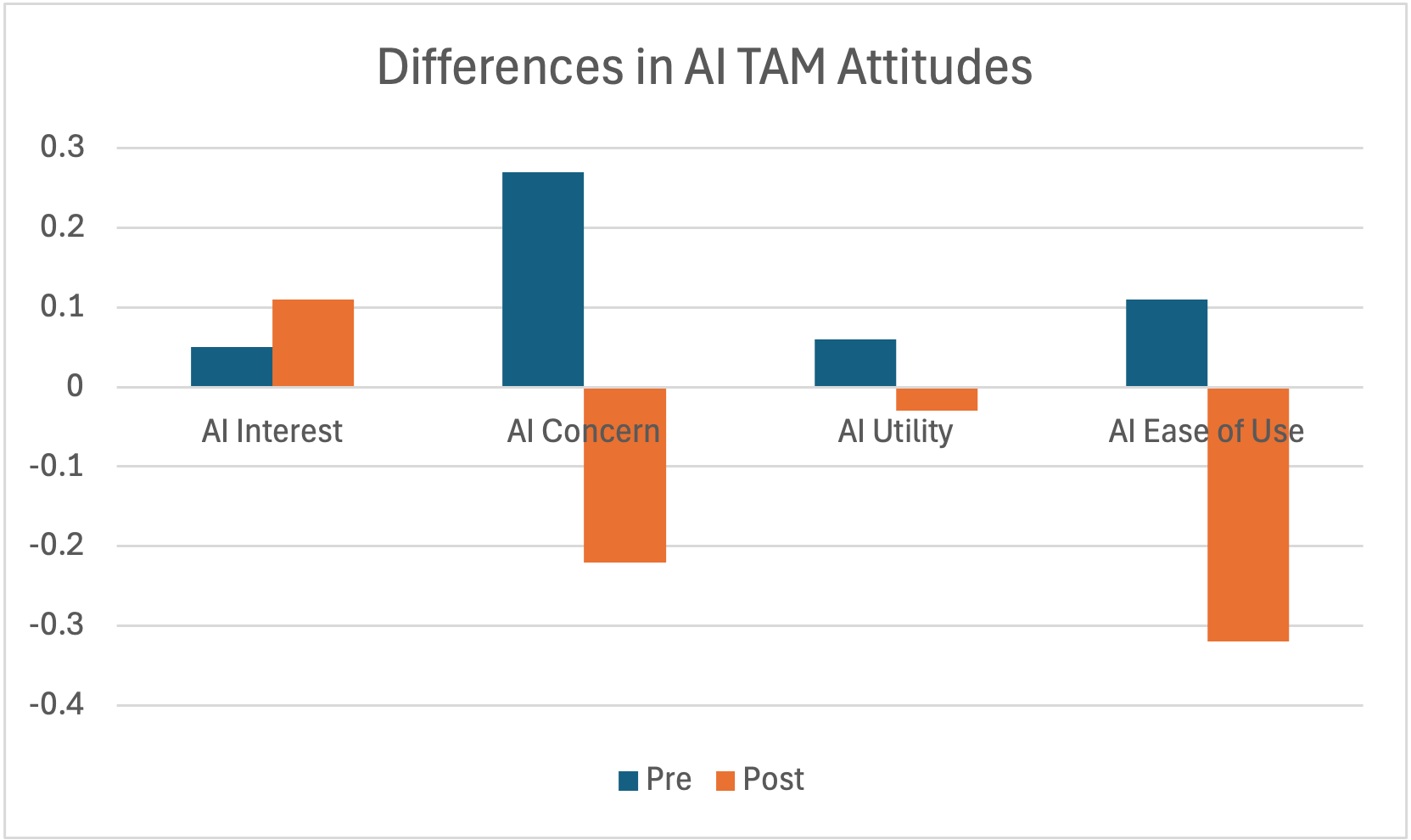
The left panel tells the more complicated story. AI Concern dropped sharply: students who arrived anxious about AI left considerably less so. AI Interest grew (but very little). Both of those feel like wins. But then there is Ease of Use, which fell by nearly half a standard deviation. Students did not find AI easier to use over the course of a semester. They found it harder.
At first that looks like failure. I’d argue it is actually the most important finding in the dataset.
Students who arrive in a course with no real AI experience often imagine it as a magic button. Ask it anything, get something back, done. What they discover when they actually try to use AI well, for learning, for writing, for sense-making, is that getting something back and getting something useful are very different things. The cognitive work of prompting thoughtfully, evaluating critically, and iterating productively is real work. It takes skill. It takes practice. A drop in perceived ease of use, in this context, is a sign that students are engaging genuinely rather than superficially.
The second panel is more straightforward. Students used AI more frequently by the end of the semester, and they felt better trained to use it. Both measures moved in the right direction. They were doing more with it and feeling more capable of doing it well.
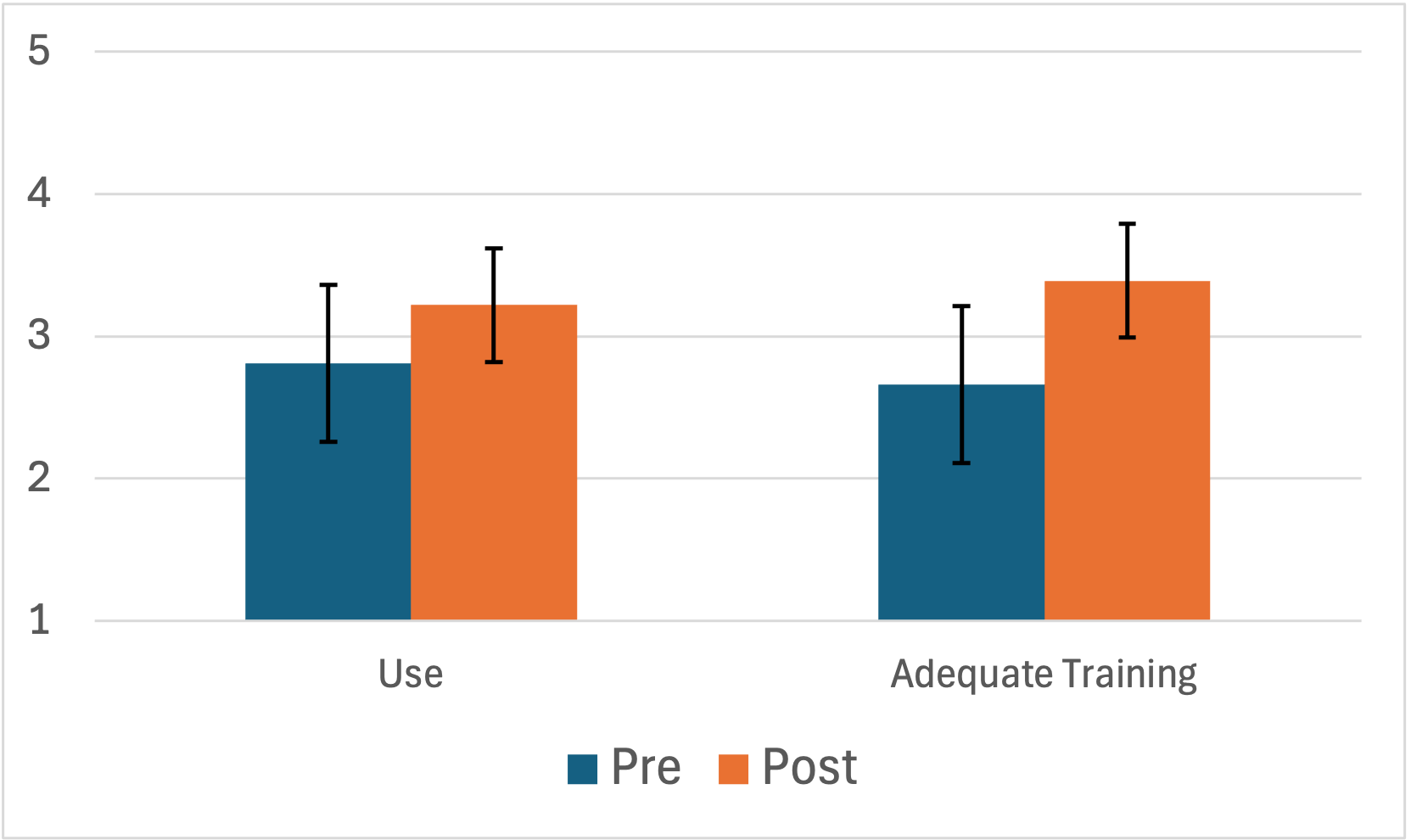
That combination, harder to use but used more and with growing confidence, is not a contradiction. It is what genuine learning looks like.
Neither experiment produced what was originally imagined. Khanmigo has not yet become the universal AI tutor. My course did not produce a cohort of frictionless AI power users. What both produced was knowledge, specific, grounded, honest knowledge about what happens when real people try to learn with AI under real conditions.
This is how we find the jagged opportunity.
The technology is not uniformly transformative. It is transformative in specific places, for specific tasks, with specific kinds of support, for specific kinds of learners. The only way to discover where those places are is to try things and pay attention to what actually happens with actual students, in actual classrooms.
We need more experiments like Khanmigo. Big ones with organizational backing, yes, but also small ones, classroom-sized ones, ones where a single teacher decides to integrate AI softly and watches carefully. We need people brave enough to design those experiments honestly, which means building in the possibility of unexpected or inconvenient results. And we need the culture to celebrate honest reporting of those results.
A few things I am taking forward from this semester. AI ease of use is not a given, and treating it as one is a mistake. Any integration that does not take seriously the cognitive demands of working with AI well is setting students up for frustration. Concern, on the other hand, is addressable. The sharp drop in AI anxiety in my classroom suggests that structured, low-stakes exposure, without requiring students to perform enthusiasm or conversely purity, can shift the affective landscape meaningfully. Fear of AI is not fixed. It responds to experience and the reactions of others around you. And frequency of use matters, but what matters more is the quality of engagement underneath that frequency. Students used AI more. I want to spend this summer understanding how.
Sal Khan tried something ambitious with real resources and real public commitment. When the results were messier than expected, his organization said so. That is a model worth following.
Education as a field has a long history of adopting technology with optimism and abandoning it without learning much in the transition. The pattern usually goes: enthusiasm, implementation, disappointment, public rebuke and dismissal. What breaks that cycle is the harder work of staying curious when the results are complicated.
Khanmigo is not over. My classroom experiments are not over. The frontier is jagged, which means there is still terrain worth mapping.
Let’s keep walking it.
Guy Trainin is a Professor in the Department of Teaching, Learning and Teacher Education at the University of Nebraska-Lincoln. He co-hosts the podcast Azadeh and Guy on AI and writes here about AI in education, research, and the messiness of figuring things out in public.